
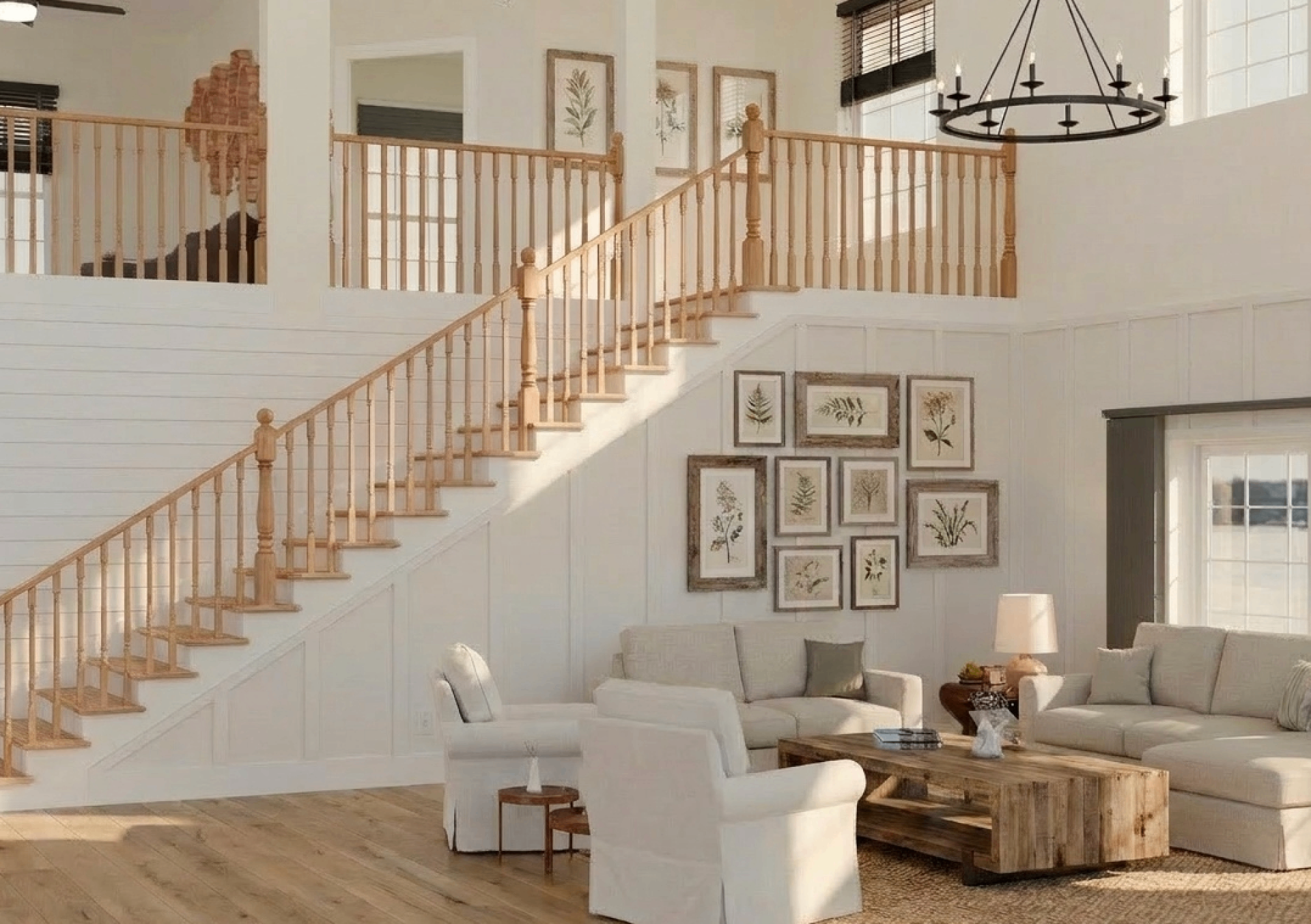
If you've ever looked at your dated staircase and assumed remodeling it meant tearing the whole thing out, here's some good news: it almost never does. The structural part of a staircase — the stringers, the framing under the treads, the carriage that supports everything — typically stays exactly where it is. What you actually see and touch every day are the finish components, and almost all of those can be swapped without rebuilding from scratch.
Here's what's on the table when you remodel a staircase, ordered from easiest change to most involved.
Level 1: Balusters. Balusters are the easiest, highest-impact change you can make. Swap turned wood for satin-black iron and you have what looks like a brand-new staircase in a weekend. Modern iron balusters install into the existing handrail and tread holes with our TAP-N-TWIST™ system — drill, drop, twist — so you don't need to tear out the handrail to do it.
Cost is low (often a few hundred dollars in parts for a typical residential staircase), and the visual change is dramatic. If you're remodeling on a budget, this is where to start.
Level 2: Handrail and newel caps. The next level up is replacing the handrail and any decorative caps on the newels. A round traditional handrail can be swapped for a square modern one, or vice versa. New newel caps can transform the look of an existing post without replacing the entire newel.
This requires more careful measurement — handrail has to fit angles, returns, and newel connections precisely — but it doesn't require structural work. A skilled installer can usually do it in a day or two.
Level 3: Newels. Replacing the full newel posts is a bigger job, but it transforms the staircase from top to bottom. Switching from ornate turned newels to clean square paneled newels (or the reverse) is one of the most-requested staircase remodels. The new newel attaches to the same structural location as the old one, but installation is more involved because the handrail typically has to be detached and re-fit.
If you're already replacing the handrail, doing the newels at the same time makes sense — you only have to do the careful handrail fitting once.
Level 4: Treads and risers. The most involved change, and often the most dramatic. If your treads are currently carpeted, removing the carpet and installing stained hardwood treads is a transformation. Carpet hides a lot of design opportunity — and a lot of nail holes and adhesive residue. Once that's gone and beautiful stained oak treads are in their place, the whole staircase reads differently.
If your treads are already hardwood but tired, you can also re-finish them in place — sand down to bare wood, re-stain, and seal. This costs less than full replacement and gives you a fresh start.
Risers (the vertical face between treads) are often painted bright white in modern installs, which contrasts cleanly with stained treads and reads architectural.
What you typically can't change. The pitch of the staircase, the number of treads, and the overall footprint are determined by the framing. Changing those requires rebuilding the structural stringers, which is a much larger project that usually involves a contractor and a building permit. If you're happy with the layout of your stairs and just want them to look different, you don't need to go there.
Where to start. The order above — balusters first, then handrail, then newels, then treads — is also the order we recommend planning a remodel. You can do all four at once for the full transformation, or stage the work over several years as budget allows. Each level stands on its own and looks intentional.
Not sure what change would have the biggest impact on your specific staircase? Try Evermark's Stair Studio™ to preview different combinations against your existing colors and flooring before you order any parts.
Have a project in mind? Visit The Stair Studio™ or get in touch.